Coming soonKindlePaperbackPaperback
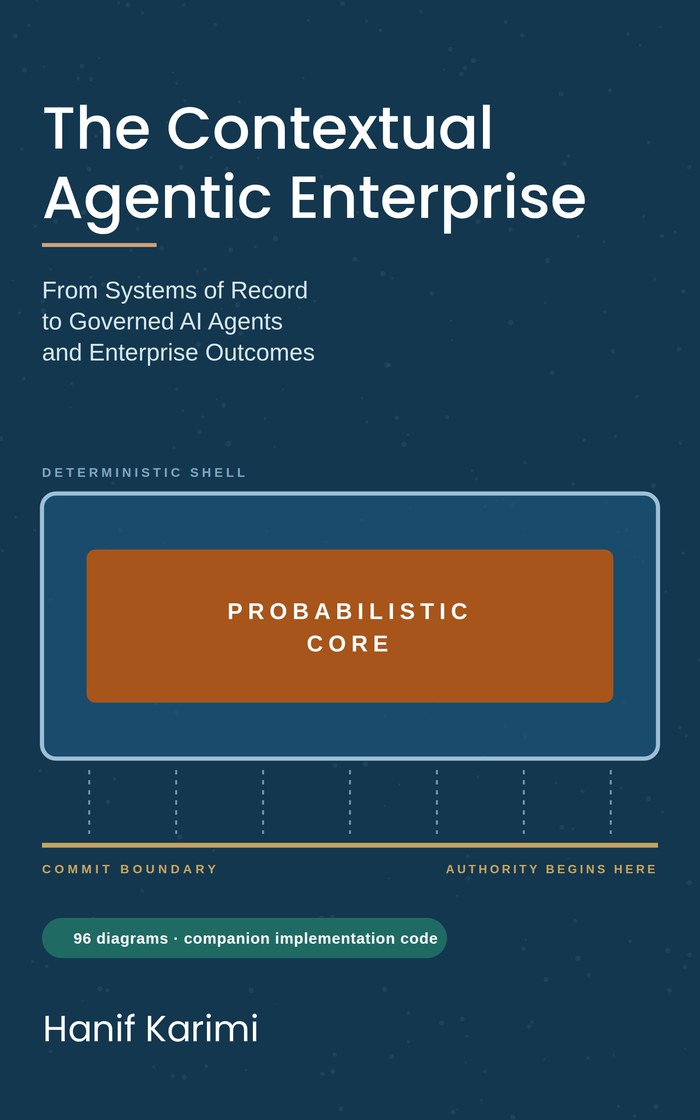
The Contextual Agentic Enterprise
From systems of record to governed AI agents and enterprise outcomes
Most enterprise AI programmes stall at the same place. The demonstrations work. The pilot is convincing. Then someone asks what happens when the agent is wrong about a customer’s contract, who authorised it to make that change, and what the auditor will be shown — and the answer turns out to be that nobody designed for any of that.
This book is about the part that comes after the demonstration. It argues that an agent becomes useful to an enterprise at exactly the moment it is given authority over real work, and that authority is an architectural problem, not a prompting one.
Two things have to be true at once. The agent has to be grounded in the organisation’s own context — its semantic model, its entitlements, its records — rather than inferring the business from documents it happened to retrieve. And the boundaries around it have to be enforced by systems that do not depend on the model behaving well: deterministic controls around variable behaviour, not a promise that the variation will stop.
The book works through what that means in practice. How to build the contextual substrate an agent reads from, and what it costs to keep it true. How authority is granted, scoped, delegated and revoked, and why the write path deserves more design attention than the read path. How to enforce boundaries with Zero Trust principles that were built for exactly this problem. How to produce evidence as a by-product of the work rather than reconstruct it under pressure afterwards. How to keep humans in a position to oversee something faster than they are. And how to be honest about the economics, including the denominator that most published figures quietly omit.
It is written for people who will have to build, review or defend these systems.
Retail links appear here once the book is on sale and each link has been verified. Nothing on this page is a purchase button yet.
What you will learn
- Design a contextual substrate an agent can act on, rather than retrieving documents and hoping
- Model authority explicitly — granted, scoped, delegated and revocable — instead of implying it in a prompt
- Apply Zero Trust principles to agent actions, including the write path
- Produce evidence as a by-product of agent work, so assurance is not archaeology
- Place human oversight where it can still change the outcome
- Reason about the economics without the denominator sleight of hand
Who it is for
- Enterprise and solution architects designing agent systems that touch systems of record
- Engineering leaders responsible for what those systems do in production
- AI governance, risk and assurance practitioners who have to review them
- Platform and security engineers implementing the boundaries
What it assumes
- Working knowledge of enterprise systems and integration
- Familiarity with how large language models are used in applications; no research background assumed
- No prior experience building agent systems is required
Contents
- Preface
- Introduction
Part I — Historical and conceptual foundations
- Chapter 1 The enterprise intelligence problem
- Chapter 2 From expert systems to agentic computing
- Chapter 3 Deterministic, probabilistic and agentic systems
Part II — Knowledge, context and semantic foundations
- Chapter 4 Enterprise knowledge and organisational memory
- Chapter 5 Context engineering and in-context adaptation
- Chapter 6 Retrieval-augmented generation, hybrid retrieval and semantic search
- Chapter 7 Ontologies, knowledge graphs, evidence and time
Part III — Agentic architecture and interoperability
- Chapter 8 Enterprise agent anatomy
- Chapter 9 Enterprise agent design patterns
- Chapter 10 Multi-agent coordination, frameworks and enterprise orchestration
- Chapter 11 MCP, A2A and capability interoperability
- Chapter 12 Agentic Flow Mining (AFM)
Part IV — Trust, security, governance and accountability
- Chapter 13 Zero Trust for the agentic enterprise
- Chapter 14 Threat modelling, identity, authorisation and tenant isolation
- Chapter 15 AI sovereignty, data residency and sovereign inference
- Chapter 16 Governance, explainability, evidence and human accountability
Part V — Engineering, integration and operations
- Chapter 17 Evaluation, reliability, observability and replay
- Chapter 18 Connecting the existing enterprise: Legacy integration and incremental modernisation
- Chapter 19 Cloud and platform architecture: Cloud-neutral, AWS and Azure
- Chapter 20 Enterprise model portfolios, routing, benchmarking and intelligence economics
- Chapter 21 Memory, continual learning and adaptive enterprise intelligence
Part VI — Economics, operating model and transformation
- Chapter 22 Operating model, FinOps, cost and productivity
- Chapter 23 From experimentation to enterprise capability
Part VII — End-to-end implementation
- Chapter 24 Three applications of the Contextual Agentic Enterprise
- Chapter 25 Building Enterprise Digital Brain, the companion CAE Intelligence Fabric
Part VIII — Research frontiers and the next enterprise
- Chapter 26 Open problems and the next enterprise
Appendices
- Appendix A Enterprise agent pattern cards
- Appendix B Zero Trust agentic security checklist
- Appendix C Architecture decision guide and example ADRs
- Appendix D Evaluation and testing cookbook
- Appendix E Enterprise model, router and memory benchmark scorecards
- Appendix F Cloud implementation mapping
- Appendix G Enterprise structured agent skill standard
Formats
| Edition | Details | Price | Where to buy |
|---|---|---|---|
| Ebook | — | Not confirmed | Not on sale yet |
| Paperback, premium colour | 7 × 10 in, 581 pages, premium colour | Not confirmed | Not on sale yet |
| Paperback, black ink | 7 × 10 in, 581 pages, black ink | Not confirmed | Not on sale yet |
Companion material
The book points at a companion repository rather than reprinting long listings. That is a deliberate trade: code that is going to change belongs somewhere it can change, and a printed path cannot be corrected once it is printed.
One address is printed in the book. Everything else is reached from there, so a change of arrangement costs a commit rather than a reprint. The repository holds the full listings that were abridged in print, the appendices that were moved out of the book to keep its extent sensible, and the figures in editable form.
Most of it is public and needs no sign-in. A smaller set is tied to a specific printing and is released to verified readers. How that verification works — and, just as importantly, what it deliberately does not do — is set out on the companion code page.
Tell me when it is available
One message when the book goes on sale, and one when companion material is released. Nothing else.
Marketing consent is never required for companion-code access or support.